Lower fork leg anatomy of a /5 BMW motorcycle

A photo diary of the internal components of a /5 BMW motorcycle fork leg.
I plan on rebuilding these forks entirely.  Good thing too.  The rubber is completely rotted in some spots and it has over 10 years of fork oil sitting in these legs. NASTY stuff.

I snapped these photos partly for the blog, but also for my own memory when it comes time to replace many of these parts and reassemble everything. But when you Look At This, please excuse the beat up linoleum floors in my garage.

Feel free to comment or ask any questions. I didn’t plan on this being a ‘How To’ post but more of a photo of the pieces and parts involved in the forks. But the post ends up being a bit of both…

Please note, i removed the entire fork assembly from the frame.  The fork rebuild can be done while still attached to the bike. When i go through the reassembly, and mount them to the triple tree, i will have to perform a strict alignment procedure to make sure the forks are installed properly.  A misaligned set of forks can cause some harmful results to the rider.  I will be sure to post my realignment procedure when the time comes.  In the meantime, for reassembly, please refer to Duane Ausherman’s site on fork alignment:
http://w6rec.com/duane/bmw/forktool/index.htm

Also, please note that i drained all the fork oil prior to starting this procedure.

I removed the upper chrome fork cap with the BMW tool

BMW fork cap pin wrench.

I then removed the upper fork bolt that secures the fork leg to the top triple tree and maintains pressure on the internal fork spring.  I believe it is a 36mm nut and it can often be secured very tightly. I recommend getting a 38mm socket and a breaker bar for the removal process.  The BMW fork wrench is often too small and you can not get the leverage needed to get that nut loose. Before i had a 36mm socket, i remember removing these nuts extremely difficult.
I snapped the following photo so i can remember that the nut had a washer, and the size of the spring spacer.  Some models do not have a washer between the nut and the triple tree. And some spring manufactures like Progressive supply a PVC piece of pipe to cut down to size for spring tension. A longer size will equal more tension. I will probably stick with the spacer that the bike has on it.  It’s a nice aluminum spacer vs PVC.

Upper fork cap removed and upper fork bolt removed.

The pinch nut for the lower triple tree needs to be removed and then the fork tubes should slide out from the triple tree.

Lower triple tree pinch nut and cable hook on right side fork leg.

The springs were taken out and the fork legs removed.

Fork Legs removed.

You need to grind a flat edge on either side of a 13mm socket.  Then install a hex (Allen) wrench in the hole of the socket.  Hold the Allen wrench in place and loosen the nut.  This will separate the chrome fork tube from the lower fork leg (lower fork slider).

Special filed down socket in which an hex tool can fit through and a wrench can keep the socket secure. Also in the photo is the 30mm socket for removing the bottom cap from lower fork leg.

I really need to invest in a good circlip tool.  I have bought a few and they never seem to have the correct tension for the precision needed in removing and installing circlips.
The circlip needs to be removed from the bottom of the chrome fork tube.(FigureA)
Then you need to unscrew the lower threaded ring from the base of the fork tube. I used needle nose pliers to fit into the small holes of the threaded ring. (Figure B – though the /5 ring looks different)

Image taken from Clymer Manual. BUY ONE!

Here is a shot of the first stage of my fork disassembled.

First photo of fork anatomy.

I already unscrewed  the threaded plug from bottom of the dampener rod.
This photo shows how to remove the upper dampener piston.

Internal fork actuator disassembly.

Photo of entire fork components… in order of their removal.

Entire fork disassembly.

Close up of the lower dampener rod’s threaded plug, spring and ball.

Close up of lower nut, spring and ball.

Close up photo of the orientation and order of the upper dampener rod and the upper piston for the dampener rod.

Close up of upper fork piston.

Cycle Works triple tree bearing removal tool

A while back I finally broke down and purchased some much needed BMW ‘only’ tools from Cycle Works. I’ve made my own tools in certain instances but i had no means of pulling the bearings from the steering column or triple tree neck.
I wish i did this on my own cafe build. I was able to clean the lower triple tree better then ever.

Cycle Works steering stem bearing puller.


Clean lower Triple Tree.

Stay tuned for photos of the races being removed from the steering column…

Airhead center stand rehab

Anybody who has ever owned an airhead from the 70s has most likely come across a broken center stand tab. The problem is that after the stand gets kicked down, most people put their foot on the tab, and not on the center stand when they lift the bike up on the stand. And, over time, the thin kick tab, and the weak weld eventually gives out.
Most people have fixed it by welding part of a nail back in the same area as the original kick tab.
I think this is one of those things BMW could have made better… so i improved upon the original design.

Click the photos for larger versions.

Here is a photo of an original center stand (taken of my 1977 R100s):

Of course, i didn’t take any photos of this particular center stand before i started the project…. dough!

Center Stand repair job:

Clean up:

****EDIT This new tab might interfere with your stock side stand. I do not use a side stand on my cafe bikes so I can’t say for sure.

Exhaust planning

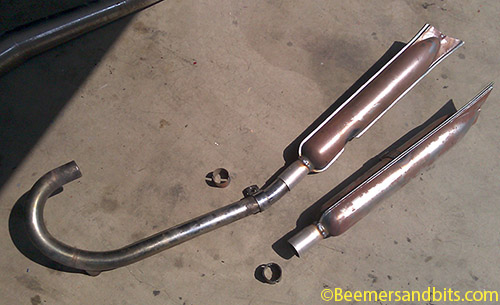
Sorry there hasn’t been too many developments on the bike as of lately. I have been doing some ‘behind the scenes’ work (noodling around and planning). A few months ago we purchased mufflers to an old R12 BMW with hopes of adding them to our /5 project. Of course, they are meant for an entirely different sized engine, and different sized header pipes.
They will take some adapting and experimenting with a /5 engine. Some critics say it won’t work (not enough back pressure). Some say it will. Some say it is a total experiment. Every ‘expert’ i talk to has a different opinion. So we are gonna roll the dice. If they don’t work, we can always switch over to a ‘standard’ set of exhaust. If they do, then we’ll have a very unique, and cool exhaust system.

We got them in bare steel with hopes to have them coated in a way in which they won’t discolor. As they sat in my garage, the basic moisture in the air started to oxidize them and a light surface rust began to appear. So i figured it was time to get cracking on them, and get them coated before they get any worse.

I’m on the hunt for a bare set of header pipes. I’m not sure if EPCO or anybody else will sell them in bare steel… but we need them naked so i can get the headers, and the mufflers coated at the same time. I’ve sent off some e-mails but nobody has gotten back to me. I may have to contact the exhaust companies directly.

Muffler straight out of the box. The collar needs to be widened to fit over the header pipes.

After a few months, these poor guys started to oxidize. I cut off the old inlet collar and had new collars welded on.

The /5 header pipe fits nicely into the new collar. The old collars are laying beside the pipes.

I actually want to mount these upside down. The ‘correct’ way is with the longer fin on the bottom. i want the longer fin on the top however there is a slight notch on one of the pipes that you would see if they were mounted upside down. That notch happens to fit directly under the foot peg for the rear brake… so maybe i go for it?

To be determined….

Case Cleaning 101

Spent an hour or two on some elbow grease this weekend.
I’ve seen worse engines but no matter, they all get nasty.
I hit it with some Engine Brite foam, a screwdriver to scrape off all the crap, a toothbrush, some highly concentrated Simple Green, water, occasional spray of some carb cleaner for those hard to reach places, and i’m still not done! There are parts of this engine that hasn’t seen the light of day in 40 years. At least now i can pick it up without getting my hands dirty.

I’ll do another round of cleaning and then I’m probably going to paint it with some high heat engine enamel… probably. It seemed to work the best out of the past 2 engines I’ve cleaned.

Dirty BMW R75/5 motorcycle engine case

Clean BMW R75/5 motorcycle engine case

Engine out and torn apart

I finally got around to getting the engine out of the frame. It is nasty and dirty. As i started to take the heads off, i started noticing some surprises.
The park plugs are brand new.
I popped off the valve cover and it looked like brand new valves and springs. unfortunately, this bike has been sitting for at least 15 years with no oil and some rust has accumulated on the springs.
At this point, i wanted to seek the expert advice of my engine mechanic. I know all the parts of the engine, but i can’t put one together… nor can i take one completely apart. I want to go entirely through this bike and make it brand new again… and that includes every piece of the engine. And it was a good thing i did.


I should have noticed the pushrod tubes were new but maybe the rust threw me off.

Dirty beast.

Engine out of the frame ready for a tear down.

Off with the heads and cylinders

As it turns out, somebody started to rebuild the engine. But they did it in a half assed way. One side has brand new valve job with new BMW valves. the other side has the original valves, just cleaned up. Clean pistons too but who the hell knows what the spec might be on them. they aren’t new BMW so maybe they were bored out? is it worth the gamble? i’d say not. The Siebenrock piston and cylinder kit is a much safer bet and upgrade. I’d rather run Nicasil cylinders to be compatible with today’s gas vs cylinders meant for the gas of the 70s.

Clean heads! wow!

The question is what to do with the heads. One may be OK, provided it has factory BMW valves and not aftermarket. The other is definitely in need of new valves to match. Do they both get new Black Diamond valves or do we replace just the one side with BMW valves? Either way, they will come completely apart and be reassembled.

Case with no cylinders

Off goes the timing cover

Good thing we went this deep into the engine. the timing sprocket and chain had a TON of slack in it. 2 of the cam followers were pretty beat too. I can’t understand somebody doing a new head job, boring out pistons and then putting it on an engine with such a slacked out timing chain.

Parts for the trash man.

Time to attack the case

Dirty beasy with the cam shaft removed

Oil Pan off.

You should have seen all the sludge caked onto the inside and outside of the oil pan. Again, i can’t believe somebody put the engine back together and was going to run it with all the sludge in there. I literally had to scrape all the old oil out of the oil pan. it was like somebody poured syrup in there and let it solidify a bit. i should have snapped a photo for the ‘wall of shame’ but i went straight to cleaning everything up.

I now have all these parts boxed up. The plan is to clean and polish the exterior parts and spray it with a thermal dispersion clear coat to help dissipate the heat from the engine. I’ll keep the stock cam shaft. I’ll have to do some research on Black Diamond valves vs BMW valves. Since we already have 2 BMW valves, we may go the cheap route and do the other two to match vs a new set of 4. Siebenrock kit will solve any piston and cylinder concerns. That kit works with the (recommends) stainless steel pushrod tubes and later seals.

Carnage. All the guts of a 1972 R75/5 BMW engine.

Lastly is the rockers. I have never seen rockers on a bike earlier then 1977. The engines on my two other bikes are from 77 and 79. It turns out that until 1973, the /5 rockers were the brass bushing type. In 1974, they switched to a needle bearing. I’ll probably want to upgrade them somehow but i’ll have to figure out what parts work with the /5 heads.

Rocker arms. /6 Needle bearing type on left. /5 Brass bushing type on the right.

BMW R75/5 flywheel lightening weight

I got the flywheel lightened from San Jose BMW.
According to my household scale, the original flywheel weighs in at about 12 pounds. Maybe a shade more.

Stock flyhweel from a 1972 BMW R75/5 motorcycle

The new lightened flywheel now weighs about 8 pounds.
Taking off 4 pounds doesn’t seem like much but that is about 1/3 of the weight removed.
In addition to removing a few pounds and making the bike a bit lighter, this should allow the engine to work easier so the RPMs can climb and drop quicker.

Lightened flywheel from San Jose BMW for a R75/5 Motorcycle.