This job should have taken me 3 minutes. Instead, it took nearly an hour and a few new curse words were invented.
You can remove the lock easily if you have the key.
Simply remove the chrome cover, and then insert the key, turn it counter clockwise until it stops (around 10 o’clock) and then wiggle and pull the key/assembly out.
If you don’t have the key and you removed the steering assembly, You can use a drift on the front of the lock, and punch the entire lock assembly through the neck. It will ruin the lock.
If you don’t have the key and you didn’t remove the steering assembly, it can be drilled out if your run a small drill bit between the brass and silver part of the lock…at the 2 o’clock position.
With a new lock, chrome cover and pivot pin from BMW, i thought the installation job would be a simple task.
It turns out that these new locks and chrome covers are different then the originals and require some modification.
Here is the new assembly from BMW:
With the key inserted, you turn the lock to line up the small flathead screw-pin with the upper shark fin and slide it into the frame.
Once it is inserted, you can turn your steering assembly/handlebars to the right.
Turn the key and press the lock into the frame. The lock’s end should insert into a hole in the neck of the tripple tree. It should go deep enough into the frame/neck that when you twist the key back, it will catch in a receded position.
Here is the hole I am referring to:
This is what a locked steering lock looks like. Notice how it is receded into the frame:
After scratching my head and swearing a few times, no matter how hard i pushed that lock into the frame/neck, it would not reach the second “catch point” to lock.
I tested the lock to make sure it fit in my spare triple tree and it did.
I then wondered if the notch wasn’t deep enough so i ground it down on both sides a bit.
It still didn’t work properly. I cleaned out the inside and then started doing some tests with grease on the lock. After i made some failed attempts with a greased up lock, i would remove it and see where grease was hitting and not hitting the innards of the frame. It seemed that i had to grind the notch even further.
I did a test fit and Bingo! It worked!
Don’t forget the small spring that goes around the end of the lock!
That spring is what provides the resistance to do the locking and unlocking.
It is BMW part number 32 32 9 016 104
I then lubed up the spring and lock and inserted it into the frame.
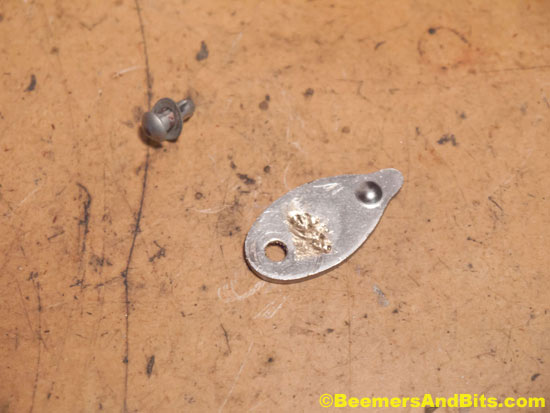
Then it came time to attach the chrome cover and pivot pin. I put it all together and then realized that the cover doesn’t slide as nice as the old one. I took it apart and realized that the old cover has a notch on the back that leaves space for a small pin that sticks out of the frame and acts as a ‘catch’ point to either open or close the cover.
Son of a B$#@@. Why can’t this job be easy?
I pulled the cover off the bike and saw that the protruding pin from the frame left some convenient scrapes on the back of the cover.
I put the plate under my drill press and shaved down a small pocket where the pin makes contact with the cover. Not the cleanest job but it works and nobody will ever see the rear of that cover.
Here is a second attempt at the rear from another bike restoration. I routed it out with a tiny routing bit:
Unfortunately, I’m not going to test the results anytime soon. The bike is undergoing an entire rebuild and I’m at the point where i am trying to make a rolling chassis. So as i wait for some fork seals from BMW, I am starting to prep all the parts for reassembly.
With the dampening rods removed from the forks, they need to be disassembled and modified.
Here is the dampening rod with the bottom nut removed and the 1/4″ drill bit to be used later.
Note that the spring and check ball get discarded when doing this modification.
Here is the upper piston removal:
It really helps if you have a drill press for something like this.
All the holes at the bottom of the rod need to be widened to 1/4″ inch.
Here are both dampener rods and an old rod. You can see the difference in hole size to allow for more oil flow. Also note my gun cleaner and airbrush nozzle cleaners in the top of the photo. The inside of the rods and holes needs to be cleaned thoroughly after you drill them. Any small sharp bits of metal will chew up your fork seals, the inner fork tube walls, and all the other moving parts.
With the piston removed, a hole needs to be added to the top of the piston to allow more oil flow to the emulator. A lathe would probably be the best tool for the job but i had to improvise with my drill press. I found it easiest to drill from the inside. And i held the piston in place with a 13mm wrench. (My method may not be the safest or smartest but it worked for me. Be Safe!).
A Before and After of the piston top.
I have read some suggestions that say to cut the top of the piston off entirely, or to cut it where the holes are. I want to be able to tighten the piston on the dampener so I drilled a hole into it. This isn’t my photo but it give you an idea of another option:
In the end, i wound up shaving down the hex head of the piston a bit. i want to make sure that the part of the emulator that sticks down in the PVC spacer does not hit the piston. I also widened the piston holes to allow for more oil flow.
Then it was off to the local hardware store to buy some 3/4″ PVC to use as a spacer between the piston and the emulator. $.64 got me a foot of pipe. More then i’ll need.
It is suggested that you cut a length between 35-40mm. Since I didn’t cut the piston, i figured 40mm would be a safe size to keep distance between the piston and the emulator. After i squared up the ends, it was more like 39mm.
If you are using Race Tech springs as well, it is suggested that you add 15mm PVC spacers at the top of the springs. The Race Tech springs are slightly shorter then stock springs.
Here is a 15mm aluminum spacer next to my PVC spacers. The aluminum spacer was on one of the bikes when I disassembled it.
It is also recommended that you use use 15wt Fork Oil set to 130mm Oil Level (from top of fork tube to oil with the fork tube at bottom of stroke & the fork spring removed.)
I’ll be sure to post back once I feel the difference between my stock /5 forks and the forks on the rebuild bike.
First, freeze your races for a day. Hopefully this will allow the metal to shrink for an easier install. Does anybody else shop at Trader Joes?
While they are cold, quickly set them into the frame and use a drift to hammer them in EVENLY.
It helps if you have an old race handy to drive the race into the frame until it bottoms out. If you don’t drive it in all the way, it will eventually settle while you are riding and your steering will require constant adjustments. If you are using an old race, try to cut a slice in the race or shave it down a bit so it doesn’t get stuck in the frame.
Here is a photo of the bottom race that is receded into the frame (with some grease on it).
Now it is time to prep the triple tree. /5’s have a small dust protector cup that sits at the base of the yolk under the bearings.
When it comes time to install the bearing, you will notice that it will not fit onto the stem.
You need to arm yourself with heat. I ended up only using the heat gun but still managed to set off a fire alarm (my wife wasn’t happy). You only heat the lower bearing by itself. That’s it. I had a scrap piece of plywood that i used as a surface to heat the bearing on.
Be CAREFUL when installing the bearing. If it is hot enough, it should drop right on. Make sure it is seated properly (Flat on the base) and it will quickly cool into position.
I noticed that the upper tightening clamp was NASTY. So i did a quick cleaning and polish… Only to realize from another BMW guru (Duane) that they were only used for a year or two on /5 and then quickly replaced by something better.
Here are all the parts. Grease up the bearings REALLY good. Grease up the races too. Plan on getting messy and working the grease into the bearings as much as you can. Then add a wee bit more.
I don’t have photos of the upper bearing install.
When you install the lower triple tree and steering stem into the bottom of the neck, you hold it into the neck as tight as possible. You don’t need to heat the upper bearing.
You set the bearing on the neck,
Then install the chrome dust cover,
Then let the tightening ring do all the work and ‘seat’ the upper bearing into the upper race.
The manual says to tighten it all the way until there is no free play anymore, and then slightly back off.
Here is the /5 Tightening nut. BAD:
Here is the /6 tightening nut. BETTER:
Then you can install the upper triple tree and steering neck nut. (Note: a San Jose Triple Tree is in the photo. Toaster Tan is another aftermarket option for triple trees.)
I wish i had the knowledge and experience to rebuild this by myself. I’ve participated in the last two rebuilds of my other BMW engines and i definitely plan on building one myself but since this bike isn’t mine, i want to make sure it gets done right.
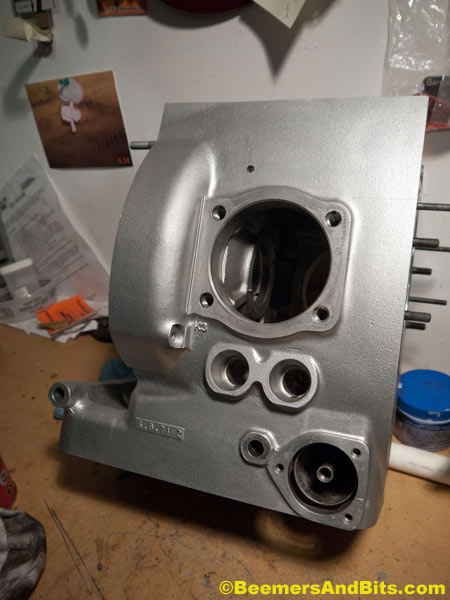
I spent some time looking over the block and doing some more cleaning.
Some inner bits and parts. Some clean, some not.
I noticed the front of the oil filter cover was chewed up along the rear edge.
I cringe every time i drag this beast out. It came from a ‘donor’ bike that a previous owner completely killed. The rod broke and engine is toast. The rest of the bike was in horrible shape as well (melted wiring, thrashed subframe, etc) . I pulled this out to yank off the oil filter cover plate and then noticed that the diode board bolts are brand new, in addition to a few other odds and ends. I think there is an aftermarket rotor on there too. This bike will always make me wonder what the history is. Hopefully someday i can resurrect it. :
Cleaned up parts, polished dipstick, super clean and shiny oil filter cover from the donor bike.
Boxed up and ready to send to San Francisco for a rebuild at Recommended Service:
While i wait for some parts to be shipped to my local BMW mechanic, might as well look at something pretty.
Looks like an Infared or heavily filtered vintage Black and White photo.
Hucky BMW sells ID Frame plates. They aren’t the same as the original plates but they look good and seem like they are made by BMW. The old name plate showed some wear and tear and would look odd against a brand new frame (even though it is tucked behind the forks).
I thought about keeping it on there for legacy… but for $17, might as well put a new one on there and keep the old one as a memento.
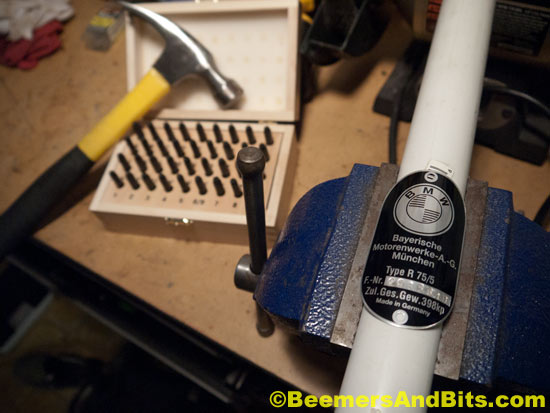
I ordered a set of 5/32″ letter and numerical dies/stamps from amazon for $16.
New ID plate
I had a piece of dowel in the garage that was similar to the arc of the steering tube that the name plate mounts to. I used that as a surface hold the plate while tapping the numbers in it.
But damn, it is hard to line those numbers up… and not slip when tapping them in. Of course I slipped on the second to last number and that one digit is out of registration compared to the others.
1/8″ 3mm Rivets seem to do the trick. I rarely use my Rivet gun but when I do, it is one of those tools I’m glad i bought. I think the 1/8″ rivets are left over from my last restoration.
I used a long socket to push the cap of the rivet into the frame as far as it could go.
A year after our wedding, my wife and i finally got around to taking a honeymoon. We started off in Paris (her choice) and then she suggested we rent a motorcycle and ride through Ireland (I’ve always wanted to see Ireland… and you know i married the right gal when she makes a suggestion like that).
After months of internet searching, I finally found Celtic Rider just outside of Dublin. I had reserved a BMW 1150GS with luggage, riding gear and a GPS.
We landed in Dublin and went to the city for a quick visit, a night in a comfortable hotel. We couldn’t help but notice how wet everything was.
The next day we woke up to pouring rain. Our car arrived to take us to Celtic Rider and we were wondering what we got ourselves into…
We met with Paul and Liam (the mechanic) at Celtic Rider and quickly realize that they were a down to earth, trustworthy, friendly and humorous bunch. Paul suggested a route to avoid the rain, made arrangements for our first Bed and Breakfast, gave us a map, and then suited us up with all the necessary gear. He had everything we could ask for in every size you could think of… Waterproof pants, jackets, boots, gloves… and of course, skid lids.
Here we are getting all geared up for a ride in the rain:
My wife was pissed this photo was taken after she was all bundled up like a child ready for the snow... and I wasn't. haha.
Paul and I went on a brief local ride to get to know the bike, and to learn about round-a-bouts and riding on the other side of the road. After that, we loaded up our luggage, my wife jumped on and Paul escorted us to the freeway heading to western Ireland.
The rain ended about an hour or two west of Dublin. Our gear held up well and we were not wet or cold. We kept referring to our ski trips where we have been much colder… Ireland was no big deal.
After about 3 or 4 hours of riding, and the guidance of our trusty GPS, we arrived in the town of Westport Ireland along the west coast of Ireland. Phew. Time to relax.
This is our bed and breakfast for the next two nights.
We went straight into town for some window shopping and dinner.
We ended up at John J O’Malleys for an amazing meal.
I saw on the menu they had ‘award winning’ black pudding. I figured it must be good…
black pudding
And it was. Amazing in fact. My wife and I devoured it. Then the waitress took our plate and asked us if we knew what it was… to which we replied “No”.
Then she said in a low voice, “It’s coagulated sheep’s blood”.
At that point, i thought my wife was going to vomit…
I was shocked as well… but we had to put it past us and remember how delicious it was. The rest of the meal was amazing as well. I recommend the Seafood Symphony!
Following the meal, we headed to Matt Molloy’s pub down the street. Matt is the flute player for the Chieftains. We were welcomed to some traditional Irish live singing however after a song or two, and a few beers, it got quiet and it was then time for bed.
Westport Ireland with the tide out.
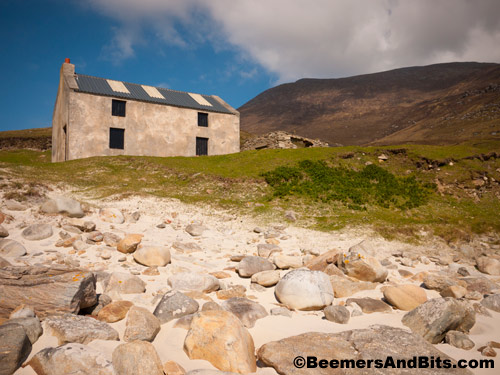
Local house in Westport
Westport at sundown.
Day 2
Breakfast and a plan.
Off to Achill Island and then to explore the North West of Ireland.
Riding to Achill was when the ride started to feel like vacation.
We finally hit the small country roads… and sheep are everywhere!
My wife's view of the road.
As we approached Keem Beach on Achill Island… we started riding high up along a cliff. Being on the left side of the road, i was getting a bit scared because it was a LONG way down should we go off the road. And then we saw the cove… it felt like we arrived at a hidden cove in Hawaii. The water was bright green/blue and totally placid. Ireland? really?
Keem Beach, Achill Island
After a nice walk around the area, it was time to ride on. We rode for another hour or two up around Ballycroy National Park to the small town of Bangor for lunch.
Then got lost thanks to the GPS trying to take us ‘As the crow flies’ though some crazy farm country (thankfully we were on a GS).
Our trusty on and off road machine.
Once we got back on route, we rode down to Castlebar and then back to Westport.
Just after taking this photo i stepped in a quicksand like mix of mud and manure. I had mud up to my knees. Luckily i found a guy washing his car with a pressure washer and asked him to hose me down.
Day 3
A LONG day of riding ahead… For some reason, my wife had it in her head that we had to make it to Dingle. Also, Paul suggested a route to Dingle from Westport with various stops along the way.
Off we go.
The ride between Westport and Clifden Ireland was probably the most spectacular part of the trip. The terrain went from mountains to valleys to rivers to lakes…
A taste of it is here… however, i apologize, my wife suffers from vertical video syndrome…
And then we ended up on the Sky Road in Clifden. It is one of the most scenic roads in the west part of Ireland.
Along the route, we stumbled upon a 200 year old abandoned castle. We parked the bike and walked down the long driveway up to the castle.
Castle off to the right.
Road to the Castle
Between the castle and the stables.
After some exploring of the castle and the area around it, i heard my wife talking to somebody off in the distance. We were greeted by Raymond who is part of nine families that own the Castle. He also politely mentioned that it isn’t open to the public but said we were OK. He gave us wonderful history about the castle, who built it and the politics that surround it. I can’t disclose the location of this castle but Raymond did say that he gets occasional visitors and was in need of money to repair the road.
Back on the road… We have lots of ground to cover…
We took in lots of scenery and had some occasional pit stops but our next major destination was the Cliffs of Moher. WOW.
Those small things atop the hill on the upper left are people.
Off to Killimer to catch a ferry across the Shannon River. We probably should have called it quits around the Kilrush / Killimer are. We covered a ton of ground… and the wife’s knees were starting to get stiff (she is a runner and can’t sit for that long). But she had it in her head we had to get to Dingle. So off we go…
Waiting for the ferry
We made it to Dingle with some sunlight to spare. phew. that was a LONG ride. Longer then we had expected. Amazing though. We went into town for an amazing Pizza, a few drinks and then exhaustion took over.
Streets of Dingle.
Day 4
After another amazing breakfast at our B&B, we started to head back to Dublin.
Our main stop on the return trip was King John’s Castle in Limerick. The castle was empty and we were the only few visiting this amazing piece of history along the Shannon River. It was build around 1209 and has a history we can’t even imagine as two people growing up in the USA.
Kink John's Castle, Limerick Ireland.
Back to Dublin… and back to the rain once we got close to Dublin.
I wish we had another week to continue riding. I guess we’ll just have to come back someday and do it again.
We were greeted by Paul when we returned to Celtic Riders. He took our GPS off the bike, went into the office for a minute and then came back and asked if the number ‘400’ on the GPS odometer meant we rode 400km or 1400km. I told him 1400 and his eyeballs nearly popped out of his head. He thought we were absolutely crazy for riding so much. After i did the math, i realized that it was only about 850 miles over 4 days. That isn’t too bad… is it?
Regardless, he was happy to see us and the bike in one piece. He helped us unload, gave us T-Shirts and chatted about our trip.
I couldn’t say enough about Paul and his crew at Celtic Rider. They are warm, welcoming, friendly, and avid motorcycle riders. The bike ran fantastic, the gear was perfect, and their guidance was spot on. I hope to visit them again someday so we can explore more of a country we came to know and love.